A private life that shaped a public story
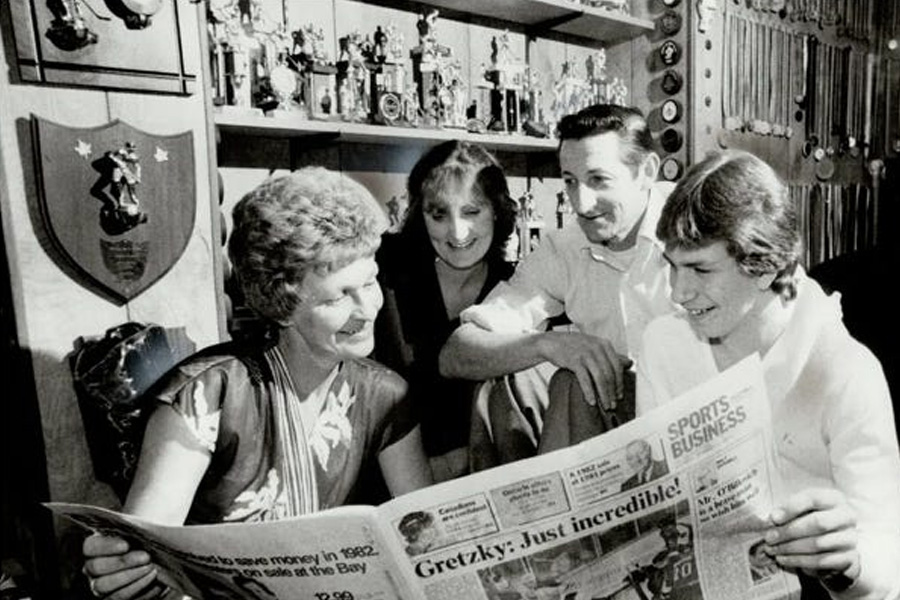
When I look at the story of Phyllis Hockin, I see a woman whose influence moved like steady water beneath ice. She was never the loud center of the room, yet the room seemed to hold together because she was in it. Born in 1941 in Paris, Ontario, Phyllis grew up in a family rooted in ordinary Canadian life, and that ordinariness became one of her greatest strengths. She later became known as the wife of Walter Gretzky and the mother of five children who carried the Gretzky name into Canadian sports history and beyond.
Her life was private in the best sense. It was not hidden because it lacked meaning. It was private because meaning was already present at home. In many families, fame pulls everything apart like wind against a weak door. In the Gretzky household, Phyllis seemed to be the hinge. She kept the door steady. She was remembered as strong-willed, warm, and fiercely devoted to her family, someone who made room for every child while protecting the shape of everyday life.
Family roots in Paris, Ontario
Phyllis Hockin was born to Harold Seymour Hockin and Betty Leone Cook Hockin. She also had at least one brother, Robert Roy Hockin. Those names matter because they place her inside a real family line, not a legend. Before the Gretzky name entered the picture, she was already a daughter, a sister, and a young woman shaped by a modest Ontario upbringing.
There is also a deeper historical thread attached to her background. She was described in public family records as a descendant of Isaac Brock, which adds a historical echo to her personal story. But I think the stronger truth is simpler. Her character came less from pedigree than from practice. She learned how to keep a household moving, how to stay grounded, and how to build a kind of emotional architecture that others could lean on.
Meeting Walter Gretzky and building a marriage
At 15, Phyllis met Walter Gretzky, then 18. They met at a wiener roast on the Gretzky family farm, which feels almost theatrical now, like the beginning of a lengthy family drama no one knew was coming. They married in Paris, Ontario, in 1960 and moved to Brantford. One of Canada’s most famous family stories began there.
Walter became the father of Wayne Gretzky, but Phyllis was the center of the home before that. Their marriage survived hard seasons, increased celebrity, and the various responsibilities of a public family during Canadian hockey’s most prominent years. She married Walter for 46 years until her 2005 death, which spoke quietly. Says endurance. Says habit. It says pressured loyalty.
The Gretzky children
Phyllis and Walter had five children, and each one carried a different piece of the family’s legacy.
Wayne Gretzky was born in 1961 and became the most famous hockey player in the world. Yet behind every early skating step and every backyard practice was a home life built by his parents. I think of Phyllis here not as a supporting character, but as the builder of the stage. Wayne’s childhood in Brantford, especially the famous backyard rink, became part of hockey folklore. That story does not happen without a parent who gives a child room to dream.
Kim Gretzky was born in 1963. She remained more private than her brother Wayne, but she is an important part of the family structure. In family stories, not every member becomes a headline. Some become the connective tissue. Kim represents that quieter layer of the Gretzky family.
Keith Gretzky was born in 1967. He later worked in hockey as well, including scouting and front office roles. That tells me something about the family atmosphere. The game was not just Wayne’s path. It was part of the air the family breathed.
Glen Gretzky was born in 1969. He lived a more private life than Wayne, but his place in the family tree matters because every family needs members who keep the circle whole without chasing the spotlight.
Brent Gretzky was born in 1972 and also played hockey. His career may not have mirrored Wayne’s, but it still reflected the family’s deep connection to the sport. In a family like this, hockey seems less like a career choice and more like a language spoken around the dinner table.
Here is a simple view of the immediate family:
| Family member | Relationship to Phyllis Hockin | Notes |
|---|---|---|
| Walter Gretzky | Husband | Married in 1960 |
| Wayne Gretzky | Son | Born 1961, hockey icon |
| Kim Gretzky | Daughter | Born 1963 |
| Keith Gretzky | Son | Born 1967 |
| Glen Gretzky | Son | Born 1969 |
| Brent Gretzky | Son | Born 1972 |
Grandchildren and the family tree that kept branching
Not content with five children, the Gretzkys continued. Phyllis became a grandmother, expanding her family line.
Her grandchildren were Paulina, Ty, Trevor, Tristan, Emma, Nathan, Austin, Zachery, Kayla, Dillon, Luke, Avery, and Mila Gretzky. In that enormous family constellation, each name adds a branch to the living tree.
Paulina Gretzky is well-known for her family and media presence. Her son River Jones Johnson is Phyllis Hockin’s great-grandson, therefore her tale continues beyond hockey history to a younger generation.
Ty Gretzky and Trevor Gretzky also have children. Thus, Phyllis is a multigenerational mother and grandma. I think that’s crucial because family legacy is more like a river than a set object. It moves, gathers tributaries, and changes shape while remaining.
Illness, final days, and the kind of legacy that remains
Phyllis was diagnosed with lung cancer in late 2004, and she died in Brantford on December 19, 2005, at the age of 64. Her death came after a period of private struggle that the public only partially saw. Wayne Gretzky stepped away from some professional duties in those final days to be with her, which says something plain and human about the family bond.
What remains after a death like that is not only grief. It is pattern. It is memory. It is the way children and grandchildren continue to speak, act, and build under the influence of a person who may no longer be present but is still shaping the room. Phyllis’s legacy was never built on speeches or public campaigns. It was built the way a house is built, beam by beam, with patience, repetition, and care.
A name still carried forward
Even after her death, Phyllis Hockin continued to be remembered in Brantford and in hockey circles. Her name appears in community awards and family tributes, which feels fitting. She was the kind of person whose influence did not need a spotlight to survive. It stayed in the habits of the family, in the stories told about the backyard rink, in the discipline and closeness of the Gretzky clan, and in the many descendants who still carry the family line.
FAQ
Who was Phyllis Hockin?
Phyllis Hockin was the wife of Walter Gretzky and the mother of Wayne Gretzky, Kim Gretzky, Keith Gretzky, Glen Gretzky, and Brent Gretzky. She was born in 1941 in Paris, Ontario, and died in 2005 in Brantford.
What made Phyllis Hockin important to the Gretzky family?
She was the emotional center of the family. I think of her as the steady frame around a house that became famous. Her role was private, but it was essential to the family’s stability and identity.
How many children did Phyllis Hockin have?
She had five children: Wayne, Kim, Keith, Glen, and Brent Gretzky.
Did Phyllis Hockin have grandchildren?
Yes. She had a large group of grandchildren, including Paulina, Ty, Trevor, Tristan, Emma, Nathan, Austin, Zachery, Kayla, Dillon, Luke, Avery, and Mila Gretzky.
When did Phyllis Hockin die?
She died on December 19, 2005, at age 64, after a battle with lung cancer.
Why is Phyllis Hockin still remembered?
She is remembered as the quiet force behind one of Canada’s most famous families, a woman whose life was rooted in devotion, resilience, and family continuity.